
Quick summary
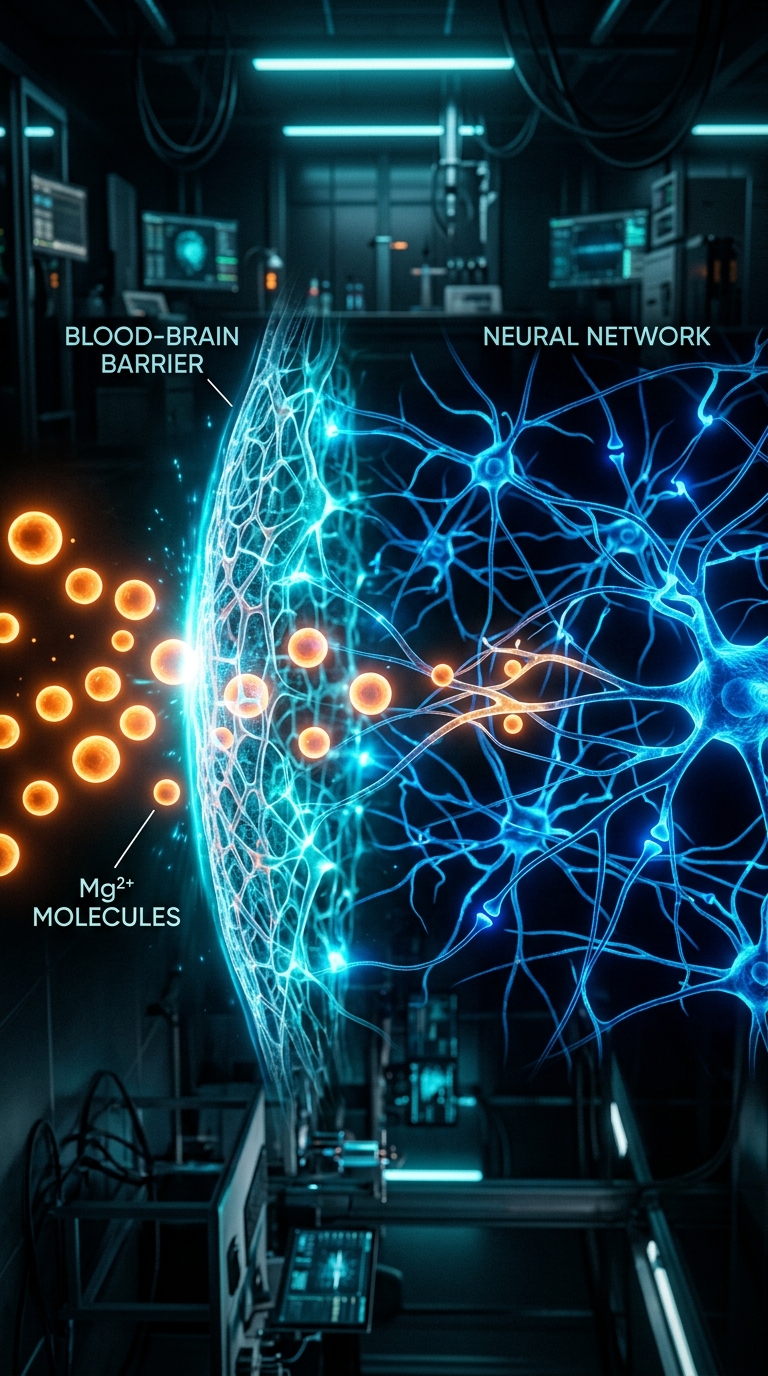
He Magnesium L-threonate It is the only form of magnesium with clinical evidence in humans to raise cerebrospinal fluid magnesium levels. Most conventional salts (oxide, citrate, glycinate, malate) do not significantly cross the blood-brain barrier. Designed at MIT as a lipophilic/hydrophilic carrier capable of transporting the Mg²⁺ ion to the central nervous system, where it modulates synaptic density and neuronal plasticity.
Mechanism of action
L-threonic acid is a metabolite of vitamin C that acts as a carrier of the Mg²⁺ cation to the brain. Once in the CNS:
- Cross the BHE: Unlike oxide or citrate, the complex raises magnesium levels in cerebrospinal fluid in animal and human models.
- Synaptic density: It increases the functional expression of NMDA and AMPA receptors in the hippocampus and prefrontal cortex.
- Plasticity and LTP: It enhances long-term potentiation, the cellular substrate of learning and memory.
- NREM-3 sleep: Clinical evidence of a higher proportion of deep sleep and reduced fragmentation.
- Enzyme cofactor: Magnesium participates in >600 enzymatic reactions, including ATP synthesis.
Clinical evidence
Robust evidence
- Synaptic density: Slutsky I et al. (Neuron, 2010) — increase in functional synapses in animal models.
- Human cognition: Liu G et al. (2016) — improvement of working memory and executive function in adults with cognitive complaints, 12 weeks.
- Sleep quality: Zhang C et al. (Sleep, 2020) — increased efficiency and NREM-3 measured by polysomnography.
Plausible / suggested
- Reduction of mild anxiety symptoms in adults with low serum magnesium.
- Support for frequent migraine (the robust evidence is for magnesium in general).
- Effect on nocturnal HRV in small studies.
Speculative / preclinical only
- Neuroprotection against Alzheimer's (murine models without clinical confirmation).
- Reversal of age-related dendritic spine loss.
Molecular form and bioavailability
Magnesium L-threonate is a 2:1 complex of L-threonic acid and elemental magnesium. It provides approximately 7.2% of elemental magnesium per gram of complex: the studied dose of 144 mg of elemental Mg requires ≈2,000 mg of L-threonate (typically 3 capsules).
In comparative models, it outperforms other salts (citrate, oxide, glycinate) by 7–9× in its ability to raise brain magnesium. It does not replace other forms for peripheral use. (cardiovascular, cramps, constipation): for that, bisglycinate and citrate are still reasonable.
Limitations and what it DOES NOT do
- It is not an acute-effect nootropic: cognitive benefit appears after 4–12 weeks of continuous use.
- It does not reverse established dementia or clinical Alzheimer's disease.
- It does not replace sleep hygiene, exercise, or cognitive training—it enhances them.
- The subjective effect is subtle; whoever seeks an immediate sensation is possibly taking the wrong thing.
Target population
- Adults with everyday forgetfulness, cognitive overload, or normal aging.
- Professionals with high working memory demands.
- Adults with fragmented sleep and measurable NREM-3 decline.
- People with low serum magnesium and mild neurological symptoms.



Reviews
There are no reviews yet