


FROM SMALLPOX TO 154 MILLION: ANATOMY FORENSIC ABOUT VACCINES
Two Centuries of Immunization, Statistics, and the Figure That Rewrote Human Demography
For millennia, infectious diseases were the oldest and deadliest enemy of human health: viruses, bacteria, and parasites decimated entire populations, toppled empires, and dictated the course of history. The extraordinary improvement in life expectancy observed in the last 150 years rests on many disciplines—sanitary engineering, agriculture, antibiotics—but one instrument stands out above the rest as the most decisive factor in reducing mortality: the vaccine.
This analysis covers that entire arc, from the first empirical attempts at artificial immunization to the most recent statistical assessment. And that assessment has a figure that should be established from the outset: according to a retrospective modeling study led by the WHO and published in The Lancet in May 2024, Global immunization programs have saved at least 154 million lives in five decades.
Module 1 — The Oldest Enemy: Smallpox, Variolation and the Birth of the “Vaccine”
A 3,000-year plague
Smallpox was, without a doubt, one of the most lethal and disfiguring diseases known to humankind. Caused by the virus Variola, did not discriminate between social classes and killed approximately 1 in 3 infected, with a death risk close to 30%, especially devastating among babies and young children. Its antiquity is astonishing: the smallpox scars on the pharaoh's mummified head Ramses V They place human cases at least as far back as 1350 BC. Because it primarily affected children, its outbreaks decimated the life expectancy of entire nations: records of Sweden The data between 1774 and 1900 show how each major epidemic coincided with abrupt drops in the average lifespan of the population.
Intentional exposure as a defense
Faced with this existential threat, different cultures resorted to variolationDeliberately exposing healthy individuals to material from the sores to induce a milder form. China, Sixteenth-century accounts describe “insufflation”—dried, crushed scabs blown into the nostrils—; in the India It was inoculated with a lancet on scarified skin. The practice reached the American colonies in 1721, when an enslaved African man named Onesimus She explained the procedure to Reverend Cotton Mather during an outbreak in Massachusetts; that same year, the aristocrat Lady Mary Wortley Montagu He formally introduced it to Western Europe after observing it in the Ottoman Empire. Variolation reduced mortality, but retained an inherent risk: it could trigger a severe illness and cause new outbreaks.
1796: Jenner and the word that comes from the cow
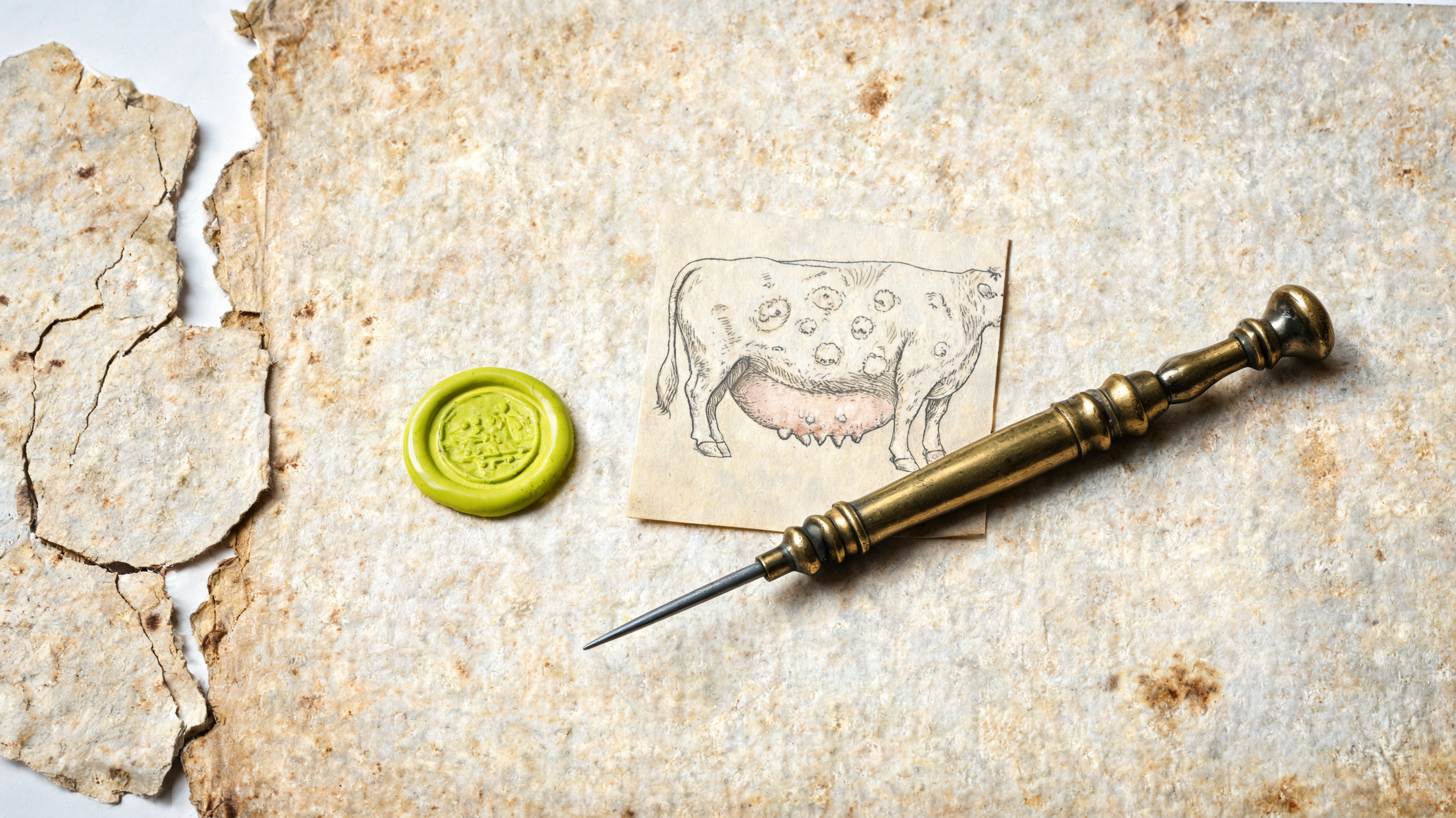
The leap towards biologically safe immunization came at the end of the 18th century. 1774, Benjamin Jesty He experimentally tested an old rural belief: that having suffered from cowpox (cowpoxIt protected against smallpox. Two decades later, the English doctor Edward Jenner He systematized the finding. In May 1796 inoculated the 8-year-old boy James Phipps with material from a cowpox sore taken from the hand of the milkmaid Sarah Nelmes. In July, he repeated the experiment with material from active human smallpox: Phipps did not get sick. The world's first effective vaccine had been born, and with it the term vaccine, derived from Latin cow (cow). Despite the skepticism—in 1802 rumors circulated that inoculation would turn people into cows—figures like Napoleon Bonaparte y Thomas Jefferson They supported its massive deployment in the early 19th century.
Module 2 — The Golden Age of Bacteriology: The 10 Oldest Vaccines

For almost eighty years, the smallpox vaccine was the only one in use: microbiology could not yet isolate and attenuate other pathogens. That changed with the Microbial Theory of Disease in the second half of the 19th century, driven by Louis Pasteur y Robert Koch. Thus began a “Golden Age” in which vaccine creation became a structured and reproducible laboratory practice.
| # | Year | Disease | Pioneers | Guy |
|---|---|---|---|---|
| 1 | 1796–1798 | Smallpox | Jenner / Jesty | Live attenuated (cowpox) |
| 2 | 1881 | Anthrax | Louis Pasteur | Attenuated organisms |
| 3 | 1884–1885 | Anger | Jaime Ferrán and Clua | Whole dead |
| 4 | 1885 | Rage | Pasteur, Émile Roux | Live attenuated |
| 5 | 1890 | Tetanus | Emil von Behring | Antitoxin (toxoid in 1924) |
| 6 | 1896 | Typhoid fever | Wright, Pfeiffer, Kolle | Whole dead |
| 7 | 1897 | Bubonic plague | Waldemar Haffkine | Whole dead |
| 8 | 1921 | Tuberculosis (BCG) | Calmette, Guérin | Live attenuated |
| 9 | 1923 | Diphtheria | Ramon von Behring Kitasato | Purified toxoid |
| 10 | 1924 | Scarlet fever | George and Gladys Dick | Erythrogenic toxin |
Pasteur, Ferran and the art of attenuation
The second big leap was led by Louis Pasteur: in 1881 He developed the anthrax vaccine, establishing that pathogens grown in the laboratory could be attenuated by chemical or thermal means. The Spaniard Jaime Ferrán and Clua created between 1884 and 1885 the first clinical vaccine against cholera in humans, with whole inactivated bacteria, and immunized on a large scale during an epidemic in Spain.
Rage and the Joseph Meister case
In 1885, Pasteur and Émile Roux They achieved the first laboratory-produced live attenuated pathogen vaccine against rabies. The treatment—13 progressively more virulent injections of the virus grown in rabbit spinal cord—was administered to the young man. Joseph Meister, mutilated by a rabid dog. Meister survived, demonstrating for the first time that prophylaxis post-Exposure could prevent the disease if applied before the virus reached the central nervous system.
Tetanus, BCG and the “angel strangler”
Active prevention against tetanus—a toxin from Clostridium tetani— matured in 1924 with the tetanus toxoid of Gaston Ramon and C. Zoeller, decisive against maternal and neonatal tetanus. BCG (1921) cost Albert Calmette y Camille Guérin thirteen years of subculture Mycobacterium bovis. And diphtheria, nicknamed “the angel who strangles children” because of the pseudomembranes that suffocated its victims, it was neutralized with the purified toxoid of 1923, following the key isolation of a toxin-producing strain by Dr. Anna Wessels Williams in 1894.
Module 3 — The Century of Viruses: Yellow Fever, Influenza and the Conquest of Polio
With major bacterial infections under control, the decades from 1930 to 1960 brought the explosion of viral vaccines and the shift from the solitary laboratory to massive industrial and state collaboration. 1937, Max Theiler perfected the legendary attenuated vaccine “17D” against yellow fever; approved in 1938, it was administered to more than a million people and earned him the Nobel Prize.
The etiological error of influenza
The pandemic of “Spanish Flu” (H1N1) of 1918–1919 It infected approximately 500 million people and killed between 20 and 50 million. For years science pursued the wrong suspect: in 1892, Richard Pfeiffer had isolated a bacterium which he mistakenly named bacillus influenzae, And in 1918, hundreds of thousands of doses of useless antibacterial vaccines were manufactured. In that alone... 1933, The British scientists Wilson Smith, CH Andrewes, and PP Laidlaw identified the real culprit: a virus. In the 1940s, Thomas Francis Jr. y Jonas Salk, Funded by the U.S. Army, they developed the first functional inactivated influenza vaccine.
Polio: the trial of 1.6 million children
Before countermeasures, poliovirus killed or paralyzed more than half a million people a year, mostly children. The key came in 1949, when Enders, Weller and Robbins They cultivated the virus in human tissue (Nobel 1954). Jonas Salk He designed the inactivated killed virus (IPV) vaccine and organized in 1954 a titanic field trial with 1.6 million children in Canada, Finland and the US. The results, announced on April 12, 1955, They were spectacular. Salk refused to patent his discovery.
“"Well, people, I'd say. There's no patent. Could you patent the sun?"”Jonas Salk, on the ownership of the polio vaccine
Since IPV did not stop intestinal transmission, Albert Sabin He developed the oral polio vaccine (OPV) using a live attenuated virus. At the height of the Cold War, he collaborated with Soviet virologists such as Mikhail Chumakov: it was tested on 10 million children in the USSR in 1959. The OPV (approved in 1960) allowed Czechoslovakia (1960) and Cuba (1962) were the first countries to eliminate polio internally, setting the precedent for global eradication campaigns led by Rotary International and the WHO since 1988.
Module 4 — The Arithmetic of Survival: 154 Million Lives

In 1974, The WHO created the Expanded Program on Immunization (EPI) to democratize access to biologics. For its 50th anniversary, the study of The Lancet (May 2024) modeled, on the Global Burden of Disease Study GBD 2023 In 204 countries, 14 major pathogens. The verdict: 154 million lives saved in 50 years, the equivalent of 6 lives every minute, every day, for five decades.
A rescue focused on childhood
The demographic profile is compelling: of those 154 million, 146 million (95%) They were children under five years old, and 101 million They were babies under one year old. Vaccination alone explains the 40% of the global reduction in infant mortality between 1974 and 2024, a percentage that amounts to 52% in Africa. For every infant death avoided, an average of 66 years of healthy life were gained: a cumulative total of 10.2 billion of years of healthy life.
| vaccine-preventable disease | Lives saved (1974–2024) |
|---|---|
| Measles | 93.7 million |
| Tetanus | 27.9 million |
| Whooping cough | 13.2 million |
| Tuberculosis | 10.9 million |
| Haemophilus influenzae type B (Hib) | 2.85 million |
| Pneumococcus | 1.63 million |
| Poliomyelitis | 1.57 million |
| Yellow fever | 554.000 |
| Hepatitis B | 464.000 |
| Rotavirus | 396.000 |
| Diphtheria | 357.000 |
| Rubella | 286.000 |
| Japanese encephalitis | 29.000 |
| Meningococcus A | 2.000 |
| Total modeling (14 pathogens) | ~154 million |
The Titan: Measles
With almost 94 million Of the deaths avoided—601% of the total impact—measles dominates the contribution to survival. It is one of the most contagious pathogens documented: a single person can infect up to 18. The live attenuated vaccine originated from the “Edmonston-B” strain isolated in 1954 and was licensed in 1963; in 1971, Maurice Hilleman It was combined with mumps and rubella in the MMR vaccine. But measles requires herd immunity of at least 95%, and the fraud published in The Lancet The 1998 study linking MMR to autism—retracted in 2010—led to a drop in coverage and a resurgence of outbreaks. Today, the WHO monitors it like a “canary in a coal mine”: its reappearance reveals any gap in a country’s coverage.
DTP, BCG and the profitability of eradicating
The package DTP (diphtheria, tetanus, pertussis) has collectively prevented more than 41.4 million of deaths, with an efficacy close to 100% against diphtheria toxin. The BCG It is probably the most administered vaccine in history: more than 4 billion of doses since 1921, and epigenetically trains the innate immune system beyond tuberculosis itself. The most extreme case is the smallpox: its eradication, certified in May 1980, It cost a mere $300 million in the 1970s; today, the U.S. recoups its entire historical contribution to that campaign every 26 days. This is empirical proof that preventative biotechnology generates astronomical financial returns.
Balance / Conclusions
First, The magnitude is unparalleled: no other medical or surgical innovation comes close to the 154 million deaths averted or the 10.2 billion years of healthy life generated in half a century. Immunization is not just another intervention, but the single most decisive factor in the historic decline in mortality.
Second, Suppression is contingent, not permanent. Except for smallpox—the only case of absolute eradication—pathogens are still present. Clostridium tetani It lives in the soil and is impossible to eradicate, and measles or pertussis reappear as soon as herd immunity falls below the 95% threshold. Protection requires continuous maintenance.
Third, Coverage has stagnated. 2024, he 85% Of the infants, approximately 109 million completed the three doses of DTP3, a recovery from the 821% in 2021 but still below the pre-pandemic 861% in 2019. The first dose against measles remains frozen in a 84%, far from the required 95%.
Room, However, a chasm of inequality persists. In 2024, 14.3 million Some babies received no vaccines at all—the so-called “zero-doses”—and another 5.6 million were only partially protected: nearly 20 million vulnerable children, more than half of them concentrated in just ten countries affected by conflict and poverty. The future imperative, according to the WHO itself, is to treat the logistics of immunization as a fundamental right for the continuation of human life.
Selected references
- Shattock, AJ, et al. (2024). Contribution of vaccination to improved survival and health: modeling 50 years of the Expanded Program on Immunization. The Lancet.
- World Health Organization (2024). Global immunization efforts have saved at least 154 million lives over the past 50 years. WHO News.
- World Health Organization. A Brief History of Vaccination. WHO Spotlight.
- World Health Organization. History of smallpox vaccination. WHO Spotlight.
- Our World in Data. Smallpox y Number of lives saved by vaccines from 1974 to 2024.
- History of Vaccines (College of Physicians of Philadelphia). Vaccine Timeline.
- Saleh, A., et al. History of vaccination. PMC / NIH (PMC4151719).
- Wikipedia. Timeline of human vaccines y BCG vaccine.
- World Health Organization. Rabies (fact sheet).
- UNICEF / WHO (2025). Global childhood vaccination holds steady, yet over 14 million infants remain unvaccinated.
- World Health Organization. Immunization coverage (fact sheet).
- CDC (2024). Routine Vaccination Coverage — Worldwide, 2023. MMWR.
- Children's Hospital of Boston. 100 years after the advent of TB vaccines.
- Spandidos Publications (2026). Global reduction in morbidity and mortality due to vaccine development against major infectious pathogens, 1974–2024 (Review).